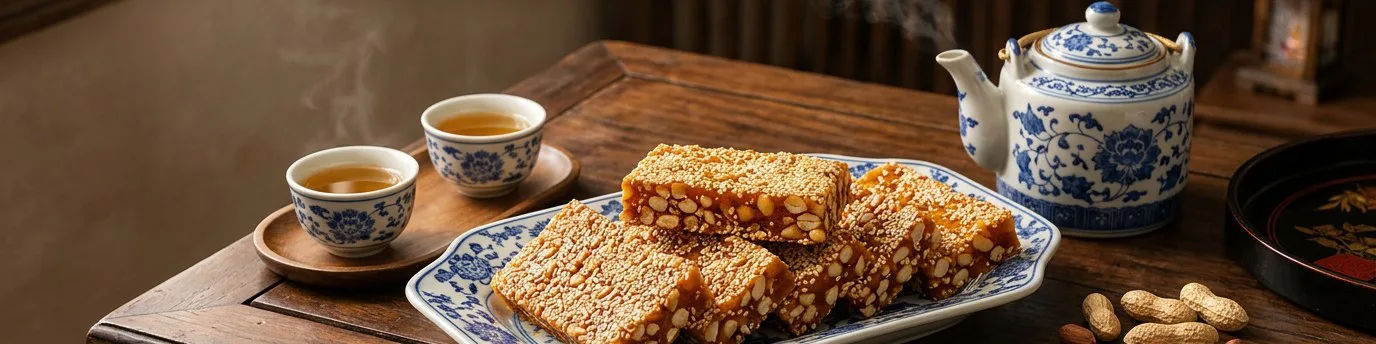
Even hearing the rustic name of Banh Cay evokes the warmth and simplicity of northern Vietnamese countryside cuisine. Handcrafted by dedicated artisans in Nguyen Village, Nguyen Xa Commune, Dong Hung District, each rectangular slice combines mellow sweetness, nutty richness, gentle crispness, and a supple malt chew. Enjoying a piece alongside a steaming cup of fragrant green tea on a chilly winter afternoon reveals the unique qualities of Cay cake that have comforted generations of families. You can browse more culinary insights in our traditional characteristics archive.
Natural Botanical Colors and a Memorable Name
First-time visitors often assume the pastry is prepared from small coastal fiddler crabs (con cay) mentioned in local folklore. In truth, learning the true meaning behind the name Cay cake shows that the confection is made entirely from golden flower glutinous rice, roasted sesame seeds, peanuts, warming spices, and natural botanical extracts. When bakers slice the pressed block, the snowy white popped rice interwoven with coral-red gac fruit ribbons and golden gardenia strips closely resembles clusters of crab eggs, inspiring its unforgettable name. Outside Thai Binh Province, no other region replicates this authentic visual and culinary harmony.
Pure Countryside Ingredients Selected with Care
Another of the unique qualities of Cay cake in Nguyen Village is how humble farm harvests are elevated into a celebrated Nguyen Village specialty once offered to kings. Master bakers carefully inspect every raw ingredient: fragrant nep cai hoa vang glutinous rice, roasted peanuts and sesame seeds, ripe crimson gac fruit, gardenia berries, sugar-marinated coconut ribbons, fifteen-day sugar-cured pork fat, golden malt syrup, candied winter melon, fresh ginger, and a touch of aromatic pomelo blossom oil.
Sophisticated Hand-Pressed Craftsmanship
Although glutinous rice forms the foundation, each secondary ingredient undergoes its own meticulous preparation before assembly:
- Botanical dyeing and crisp frying: Glutinous rice is split into portions steamed either with red gac fruit pulp or yellow gardenia juice. Both colored batches are pounded with wooden pestles into smooth dough, rolled flat, sliced into matchstick strips like winter melon jam, dried thoroughly, and fried in hot fat until they puff into light, crispy sticks.
- Popping, curing, and glazing: A separate portion of golden flower glutinous rice is dry-roasted until the kernels burst into fragrant white blossoms and are winnowed clean. Peanuts and sesame seeds are toasted and rubbed free of skins; sugar-cured pork fat is diced and simmered until translucent and crisp; and shredded carrots are sautéed with sugar, fresh ginger juice, and minced tangerine peel.
- Natural preservation without oven baking: All prepared elements are folded into bubbling sugar and malt syrup over a steady flame until the exact aroma and thread-like viscosity are achieved. The warm mixture is compacted inside sesame-lined wooden molds, cooled until firm, unmolded, and wrapped.
Remarkably, when artisans balance the sugar-malt reduction and moisture content properly, the finished pastry stays fresh for months without sun-drying or oven baking. Experiencing the fascinating flavor of traditional Cay cake with hot green tea allows every guest to feel the patience, warmth, and devotion wrapped inside each handmade slice.