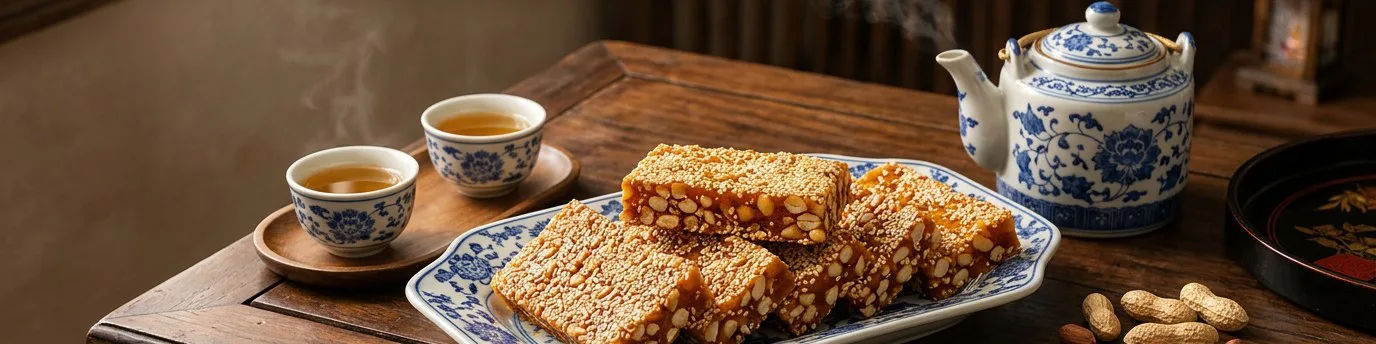
Every region of Vietnam is celebrated for a signature delicacy that reflects its land and people: Hai Duong is famous for sweet mung bean cakes, Thanh Hoa is known for fermented nem chua, and Thai Binh is universally admired for traditional Banh Cay. Understanding the defining characteristic of Cay cake made in Nguyen Village, Nguyen Xa Commune, Dong Hung District allows food lovers to appreciate why this humble countryside confection became a nationwide symbol of hospitality. Readers can explore more sensory profiles in our Cay cake characteristics archive.
Royal Invention and the Five-Spice Heritage
In centuries past, Banh Cay was reserved for Lunar New Year celebrations, ancestral altars, and royal tributes. According to village records, this warm, spicy-sweet pastry was created by Lady Nguyen Thi Tan, a sixth-generation daughter of the Nguyen Cong clan in Nguyen Xa Village (formerly Tran Khe Subdistrict, Tien Hung Prefecture) and the daughter of court scholar Nguyen Doan Tuc. Born in 1725 and admired for her quick intellect, she entered the imperial palace in 1739, where she served as a royal instructress and nursemaid.
Surrounded by court delicacies yet longing for the honest flavors of her rice-growing homeland, she combined familiar rural ingredients into an innovative confection originally called Banh Ngu Vi (Five-Flavor Cake). When she presented the pastry to King Le Hien Tong, the monarch praised its invigorating aroma and noticed that the cross-section of crimson, golden, and creamy-white ribbons resembled the speckled roe of coastal fiddler crabs (con cay). He bestowed the name Banh Cay, and from that day forward, tracing the history of Cay cake in Nguyen Village meant celebrating an annual royal tribute tradition that still thrives in Nguyen Xa Commune today.
One Month of Preparation for Perfect Texture
A core characteristic of Cay cake is its multi-textured bite—simultaneously chewy, crisp, nutty, and gently warming—which requires master bakers to begin preparing ingredients up to a month in advance:
- Three-part glutinous rice processing: Artisans select plump nep cai hoa vang (golden flower glutinous rice) and divide it into three distinct batches. The first batch is steamed with fresh gac fruit arils to yield a deep crimson color; the second is steamed with gardenia fruit infusion for a bright golden hue. Both steamed batches are pounded in mortars until elastic, rolled thin, sliced into slender strips like candied winter melon, dried, and fried in pure lard until puffed and crisp. The third batch of raw glutinous rice is dry-roasted over medium heat until the grains pop into snowy white blossoms, which are sifted clean of husks.
- Cured pork fat and aromatic fruits: Select pork fat is salted and layered with sugar for fifteen days until cured, then finely diced and simmered until translucent and delicately crunchy. Meanwhile, peanuts and sesame seeds are roasted and hulled, carrots are glazed in sugar and ginger water, and fresh tangerine peel is finely julienned.
- Malt binding and wooden mold pressing: Crushed fresh ginger and golden malt syrup are simmered over a gentle fire with the popped rice grains, crispy colored sticks, cured fat, and candied peels until a supple, cohesive mass forms. Bakers press the hot mixture firmly into rectangular wooden molds lined with toasted sesame seeds, peanuts, and shredded coconut.
Why Thai Binh Remains Unrivaled
Once cooled and unmolded, the block is sliced into neat rectangular bars and packaged. Each bite delivers the mellow sweetness of malt, the warming spice of ginger, the savory crunch of cured fat and roasted nuts, and the floral fragrance of golden flower glutinous rice. Although workshops outside the province occasionally attempt the recipe, none match the standard of Thai Binh as the authentic homeland of Cay cake. The rich alluvial soil, coastal breeze, and superior local glutinous rice combine with generations of artisan intuition to make Thai Binh Cay cake a treasured gift for every household across Vietnam.