
Across more than two centuries of historical change, developing Cay cake craft in Nguyen Village (Nguyen Xa Commune, Dong Hung District) has transformed a seasonal household delicacy into a thriving rural industry. Like many communities across the Red River Delta, Nguyen Xa was historically rooted in wet-rice farming. Drawing on abundant local harvests of golden flower glutinous rice, peanuts, sesame seeds, and aromatic ginger, village elders created a distinctive confection that has been passed down through generations. Today, residents still maintain the ancestral shrine honoring the founder of the craft while sharing updates on local artisans in our village news and heritage archive.
Preserving Secret Family Recipes and Natural Ingredients
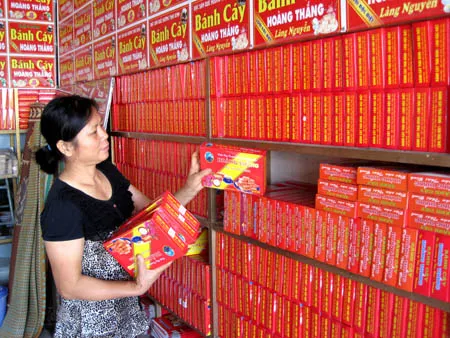
Even as production scales up, the foundation of the pastry remains faithful to the history of Cay cake in Nguyen Village. Master bakers select aromatic Nep Hoa Vang glutinous rice, pairing popped paddy grains with dough kneaded alongside red gac fruit or golden gardenia extract to form crisp pellets known locally as con cay. Sugar-cured pork fatback, roasted peanuts, filtered molasses or barley malt, fresh ginger juice, and a hint of cardamom or pomelo blossom oil are blended over gentle heat before being pressed into rectangular or cylindrical wooden molds. Wrapped in traditional crimson packaging adorned with auspicious calligraphy for weddings, longevity banquets, and ancestral altars, each family workshop guards its own subtle ratio of spices to maintain the fascinating flavor of authentic Cay cake.
Technological Innovation and Household Enterprises
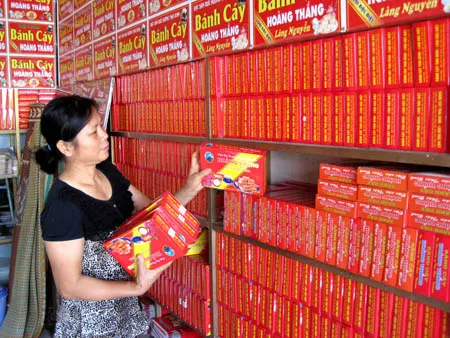
Over recent decades, developing Cay cake craft has relied on a smart balance between heirloom culinary techniques and modern food-processing equipment. Rather than performing every exhausting step by hand as in the past, village workshops have invested hundreds of millions of VND in mechanical dough kneaders, precision candy-cutting machines, automated stirring woks, rotary roasting drums, electric drying ovens, and hygienic wrapping lines:
- Widespread Local Employment: Roughly 1,500 households in Nguyen Xa participate in confectionery production and supporting services, engaging more than 70 percent of the commune's total rural workforce.
- Year-Round Production Workshops: Over 50 large-scale workshops operate continuously throughout all four seasons, creating stable jobs for hundreds of local laborers with reliable monthly incomes, while production peaks dramatically during the three-month Lunar New Year and spring festival season.
- Generational Family Businesses: Veteran artisans such as Nguyen Trong Chien, who learned the trade from his father in North Lang hamlet, now produce nearly a ton of confectionery each month—equivalent to 3,000 to 4,000 boxes distributed to agents inside and outside Thai Binh Province.
- Closed-Loop Commercial Bakeries: Major establishments like the Hoang Thang production facility utilize closed-chain machinery to supply 7 to 8 tons of finished cake monthly across 40 provincial dealerships, generating hundreds of millions of VND in annual revenue while reducing manual labor intensity.
Quality Standards and Brand Reputation
While modern machinery streamlines kneading, slicing, and packaging, Nguyen Village bakers emphasize that equipment never replaces the artisan's palate. Every workshop competes on ingredient purity, carefully sourcing plump golden flower sticky rice, chemical-free gac fruit, and mature spicy ginger grown in alluvial soil. Strict quality control ensures that each batch retains the signature balance of crispness, chewiness, and natural fragrance that distinguishes genuine Dong Hung confectionery from mass-produced imitations.
A Pillar of Rural Economic Transformation
By investing in clean production technology and attractive commercial design while protecting the unique characteristics of Cay cake, Nguyen Xa has emerged as a flagship model of socio-economic development in Dong Hung District. Today, small-scale industry, trade, and village services generate more than 80 percent of the commune's economic structure, lifting average per-capita income and raising the proportion of well-off and prosperous households above 80 percent across the community.
In addition to upgrading mechanical equipment, commune authorities and the Nguyen Xa Craft Village Association have actively supported local households in registering collective trademarks, standardizing food-safety certifications, and expanding distribution networks into supermarkets and regional specialty stores across Hanoi, Hai Phong, and Ho Chi Minh City. Training workshops held in collaboration with provincial agricultural extensions help younger artisans master both traditional malt-simmering techniques and modern inventory management, ensuring that the ancestral trade continues to thrive across generations.
Looking ahead, Nguyen Xa plans to link its flourishing confectionery workshops with rural experiential tourism along the Red River Delta heritage trail. Visitors exploring Dong Hung District can observe the entire baking process firsthand—from popping golden flower paddy in cast-iron pans to pressing warm, sesame-coated bars into wooden frames—before purchasing freshly wrapped boxes directly from family-run bakeries. This synergy between cultural preservation and modern enterprise cements the village's reputation as the heartland of Thai Binh culinary craftsmanship.