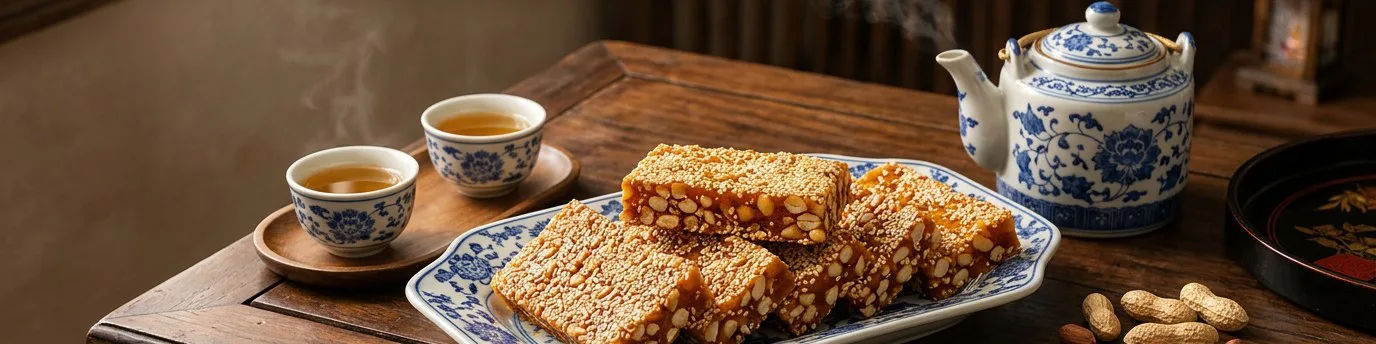
Making delicious Thai Binh Cay cake requires patience, culinary intuition, and a deep respect for the agricultural bounty of Vietnam's Red River Delta. To achieve the signature chewy texture, warm ginger aroma, and nutty richness that define this countryside confection, village bakers must harmonize locally grown ingredients with the practiced dexterity of their hands. Across generations, the artisans of Nguyen Xa have preserved every step of this intricate process, transforming humble paddy harvests into a celebrated royal delicacy.
The Geography of Thai Binh and the Royal Origins of Cay Cake
In the heart of the Red River Delta, few provinces possess a geography quite like Thai Binh. Surrounded on all four sides by winding rivers and the East Sea, the province resembles a fertile alluvial island nourished by silt-laden waters. For thousands of years, its communities have been bound to wet-rice cultivation, developing a rich rural culture and a distinctive culinary identity. Among the many specialties born from these golden rice fields, none is more famous than the royal tribute confection known as Cay cake.
The documented history of this specialty dates back to the 1740s during the eighteenth century in Co Coc village, Than Khe district, Tien Hung prefecture—known today as Nguyen Xa commune in Dong Hung district, Thai Binh province. According to historical records and village chronicles, a virtuous woman named Nguyen Thi Tan was selected to serve in the imperial court of King Le Hien Tong in Thang Long as a royal wet nurse and tutor. Because Lady Tan had no biological children of her own, when Crown Prince Le Duy Vy was born, the king entrusted the young prince directly to her care.
Prince Le Duy Vy grew into an upright heir who aspired to restore rightful authority to the Le monarchy. Threatened by his ambition, Lord Trinh Sam fabricated charges against the prince and cast him into captivity. During his confinement, only Lady Nguyen Thi Tan was permitted to visit and bring him meals. Seeing that the prince had lost his appetite and could not swallow the coarse prison rations, she devised a nourishing, long-lasting pastry made from glutinous rice, candied pork fat, roasted nuts, and warming fresh ginger to sustain his strength.
When court officials discovered her devoted efforts to support the imprisoned prince, Lady Tan herself was detained for more than ten years until the forty-third year of the Canh Hung reign. Years later, after Prince Le Duy Vy's son ascended the throne as Emperor Le Chieu Thong, the court honored Lady Tan's unwavering loyalty to his late father with noble titles. Returning to her ancestral home in Nguyen village, she taught the villagers her secret recipe, founding a thriving craft guild that continues to flourish across our traditional cake making archive.
Selecting Ingredients and Mastering the Multi-Stage Recipe
To understand the craft of making delicious Thai Binh Cay cake, one must first examine the raw ingredients gathered from local farms and gardens. Master bakers select only plump, fragrant golden flower glutinous rice, ripe red gac fruit, gardenia seeds, sweet winter melon, white sesame seeds, firm groundnuts, golden maltose syrup, fresh ginger root, and pure pomelo blossom essential oil. Although sticky rice forms the foundation of the pastry, each secondary ingredient undergoes its own meticulous preparation before reaching the mixing wok.
- Coloring and Pounding the Dough: The glutinous rice is divided into two separate portions. One batch is steamed with fresh gac fruit aril to create a vibrant coral-pink hue, while the second batch is infused with gardenia fruit extract to produce a bright golden yellow. Both portions are pounded thoroughly in a stone mortar until smooth and elastic like traditional rice cakes, then rolled flat, sliced into slender strips, dried in the breeze, and deep-fried in pork fat until they puff into crisp, colorful granules.
- Roasting the Grains and Nuts: A third portion of whole golden flower glutinous rice in the husk is dry-roasted in a cast-iron pan until the grains pop open into snowy white blossoms, after which the husks are winnowed away. Meanwhile, locally grown peanuts and sesame seeds are slow-roasted until aromatic and crisp, with their skins gently rubbed off.
- Caramelizing the Binder: Candied pork fat, cured in sugar for two weeks until translucent, is combined with candied winter melon, finely shredded ginger, cane sugar, and maltose syrup over a gentle fire. Readers who wish to explore each technical detail can consult our guide to traditional Cay cake making methods for step-by-step insights.
Why Is the Pastry Named After the Coastal Fiddler Crab?
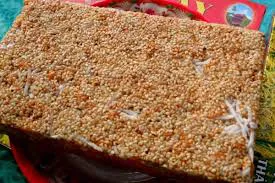
Once the caramelized syrup reaches the exact thread stage and perfumed pomelo blossom oil is stirred in, the baker folds the popped rice, crispy colored granules, and roasted peanuts together until evenly coated. The hot mixture is pressed firmly into wooden molds lined with toasted sesame seeds, rolled smooth, and sliced into neat rectangular bars. Many first-time visitors wonder why this sweet confection is called Banh Cay, asking whether it contains actual crab meat or crab roe.
In truth, the pastry contains no seafood whatsoever. The name arose centuries ago because the tiny coral-red and golden-yellow fried rice granules closely resemble the clusters of roe carried by the con cay—a small brackish-water fiddler crab common along Thai Binh's coastal estuaries. Today, whether enjoyed in cozy village courtyards or sent abroad as a nostalgic gift, the spicy and fragrant Thai Binh Cay cake retains the exact authentic taste that once comforted royalty and made Nguyen village famous throughout Vietnam.
To learn more about our editorial curation and research standards, visit our comprehensive site mission and archive overview.